

What Are Ways-to-Win Slots and How Do They Work?

What Are Ways-to-Win Slots and How Do They Work?

Modern online slots do not always use the horizontal, diagonal, or zigzag paylines found in traditional machines.

Many titles instead use a system called “ways to win,” where matching symbols can form payouts across adjacent reels without following a specifically drawn line.

Understanding what ways-to-win slots are and how they work begins with the reel layout. A typical game may have five reels with three or four visible positions on each reel.

Instead of checking whether symbols sit on one selected line, the software checks every eligible symbol position across consecutive reels.

A winning combination usually starts on the leftmost reel and continues through adjacent reels. However, exact requirements vary by title.

Some games use 243 fixed ways, while others provide thousands of routes or dynamically change the number on every spin.

The number of ways does not reveal how frequently a game pays or whether it offers better value. Players must also examine its paytable, stake rules, return to player, volatility, wild symbols, and bonus mechanics.

What Does “Ways to Win” Mean?

A ways-to-win slot does not require matching symbols to land on a predefined payline. Instead, the same symbol can usually appear in any visible position on consecutive reels, beginning with the first reel.

For example, NetEnt’s Twin Happiness uses 243 ways and states that matching symbols must appear on three or more adjacent reels, starting from the leftmost reel. Its rules do not require those symbols to sit on the same horizontal row.

Suppose a tiger symbol appears at the top of reel one, the bottom of reel two, and the middle of reel three. Those symbols may still form a payout because their vertical positions are irrelevant under the ways system.

How Is the Number of Ways Calculated?

The advertised figure is commonly calculated by multiplying the number of active positions on every reel.

A five-reel game with three positions on each reel has:

3 × 3 × 3 × 3 × 3 = 243 ways

A six-reel game with four positions per reel has:

4 × 4 × 4 × 4 × 4 × 4 = 4,096 ways

Play’n GO’s Tomb of Gold II, for example, uses six reels, four rows, and 4,096 ways. Matching symbols pay across adjacent reels from left to right.

This figure represents the available routes across the complete layout. It does not mean every route wins during a spin.

How Multiple Symbol Combinations Are Counted

A single spin can produce several winning ways for the same symbol. The game counts the number of matching symbol positions on each consecutive reel and multiplies them together.

Imagine that the same symbol appears twice on reel one, once on reel two, and three times on reel three. If three matching reels qualify for a payout, the result contains:

2 × 1 × 3 = 6 winning ways

The amount for one qualifying three-symbol combination is then multiplied by six. When the symbol also appears on reel four or five, longer and potentially different-paying combinations may apply according to the paytable.

Players do not need to calculate this manually during play because the software evaluates every combination automatically.

Fixed and Dynamic Ways-to-Win Slots

Some games maintain the same grid and number of ways on every base-game spin. A five-by-three layout may therefore remain at 243 routes throughout normal play.

Other slots expand the grid during bonus rounds. NetEnt’s Jungle Spirit begins with 243 ways, while its expanded four-row free-spin layout increases the number to 1,024.

Dynamic systems can change reel height from one spin to another. Play’n GO describes Blitzways as a dynamic structure in which individual reels can display between two and seven symbols, creating up to 16,807 ways.

Always check the current ways counter because the maximum advertised number may not be active during every spin.

How Wilds, Scatters, and Cascades Affect Wins

Wild symbols generally substitute for selected regular symbols and can complete more adjacent-reel combinations. The exact substitutions and exclusions should be listed in the game rules.

Scatters usually work differently. They may pay in any position or trigger free spins without needing to begin on the first reel. Their behaviour is independent of the standard ways calculation.

Cascading features remove winning symbols and replace them with new ones, potentially creating additional payouts from one paid spin. These extra wins come from the feature rules, not because the slot automatically has more base-game ways.

Ways to Win, RTP, and Volatility

More routes do not automatically create a higher return to player. RTP describes the game’s theoretical long-term return relative to total stakes, while volatility describes the distribution and size of prizes.

The UK Gambling Commission explains that RTP becomes meaningful over a large volume of play and that short-term results can vary because of volatility.

It defines high-volatility games as tending toward larger but rarer prizes, while lower-volatility games generally distribute smaller prizes more frequently.

A 4,096-way slot can therefore have a lower RTP or higher volatility than a 20-payline game. The mechanism describes how combinations form, not the player’s expected profit.

Are Ways-to-Win Outcomes Random?

At licensed online casinos, digital slot outcomes should be generated through tested random systems.

Under UK technical standards, random number generation must be unpredictable and produce results according to the game’s expected mathematical probabilities. Adaptive behaviour that changes outcomes based on an individual player is not permitted.

Each spin is therefore a separate event. A long period without a win does not guarantee that a payout is “due,” and changing the spin timing does not improve the next outcome.

Ways-to-win slots replace fixed lines with combinations formed across adjacent reels. Matching symbols can usually land in any vertical position, provided they begin on the required reel and continue consecutively.

The game may use a fixed number such as 243 or 4,096, or dynamically change its reel heights and available routes.

Before playing, open the information panel and check the starting-reel rule, minimum matching symbols, active grid, bet amount, wild behaviour, RTP, and volatility.

Do not assume that more ways mean more frequent wins or better value. Use demonstration mode to learn the mechanism, establish strict time and spending limits, and treat every spin as paid entertainment rather than a source of income.
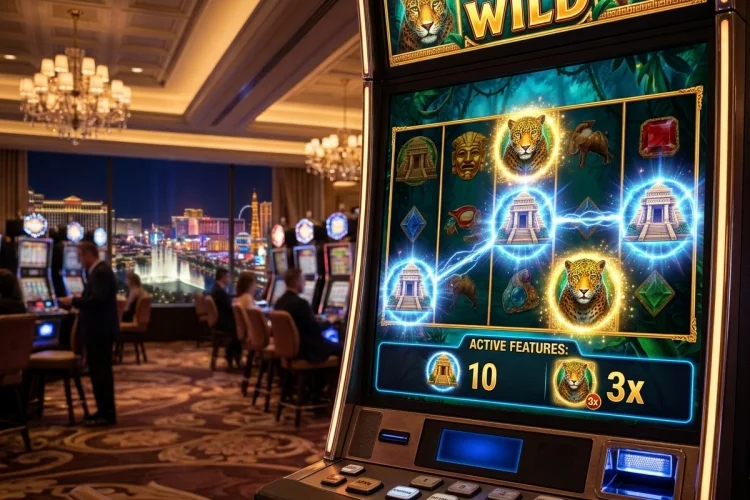
What Are Wild and Scatter Symbols? Rules, Features, and Examples

What Are Wild and Scatter Symbols? Rules, Features, and Examples

Seeing several special icons land on a slot screen can be exciting, but the result may be confusing when their functions are unclear.

A large “WILD” label may complete a prize, while three themed objects elsewhere on the grid may suddenly launch a free-spin feature.

To interpret these moments correctly, players need to know what Wild and Scatter symbols are. Wilds generally interact with standard combinations by substituting for other paying icons.

Scatters usually operate separately from paylines and activate an award when the required number appears. The challenge is that there is no single rule covering every game.

Some Wilds expand only after contributing to a win. Others remain sticky throughout a bonus or carry multipliers. Scatters may award a fixed number of free spins, increase the reward according to quantity, or reveal a separate prize.

The safest approach is to treat the paytable as the game’s instruction manual. It explains what each symbol does and prevents assumptions based on another slot with different rules.

Start With the Paytable

The paytable lists the ordinary symbols, their potential values, and the combinations needed to create an award. It should also contain a separate explanation for Wilds, Scatters, bonus icons, free spins, and other special features.

Check where winning combinations must begin. Traditional paylines often evaluate matching symbols from the leftmost reel, while cluster-pay or ways-to-win systems may use different patterns.

Next, examine the restrictions. A Wild may substitute for every standard symbol but exclude Scatters and bonus icons. A Scatter may appear anywhere, only on selected reels, or only in the base game.

These small details determine whether a group of special icons has actually created an award.

Reading a Standard Wild

Consider a hypothetical five-reel game with 20 paylines. One payline contains a crown on reel one, a crown on reel two, a Wild on reel three, and unrelated icons afterward.

When the rules allow the Wild to replace the crown, the line is evaluated as three matching crowns. The resulting payout depends on the crown’s listed value and the active stake.

If the Wild itself has a payout, the software may evaluate whether treating it as a Wild combination or a replacement produces the eligible result defined by the game.

This substitution process happens automatically. Players do not manually choose which icon a Wild represents.

Reading an Expanding Wild Feature

An expanding Wild initially occupies one position and then grows according to the game rules. Expansion might occur whenever it lands, only when it contributes to a prize, or only during free spins.

In Wild Water, Wild symbols can appear during both the main game and free spins. During the bonus, a Wild that contributes to a winning combination expands to cover its entire reel.

This example shows why timing matters. A symbol can behave normally in the base game but gain an enhanced function after the free-spin round begins.

Players should check whether expansion occurs before or after combinations are evaluated and whether the enlarged symbol remains for another spin.

Reading a Scatter Trigger

Suppose a game states that three Scatters award ten free spins. If those icons land on reels one, three, and five, they may trigger the feature despite appearing on different rows.

Book of Dead follows this type of structure: three Scatter symbols unlock ten free spins. A normal paying icon is then selected to become a special expanding symbol during the bonus.

Other games require more than three. Gates of Olympus Super Scatter uses four or more standard Scatters to activate its free-spin feature.

The trigger quantity should therefore be checked before every new game.

Retriggers and Additional Scatters

Scatters can sometimes appear during an active free-spin feature. When the required number lands, the game may add more spins, restart the feature, or provide another type of reward.

This process is commonly called a retrigger. The number needed for a retrigger may differ from the initial requirement.

A game might require three Scatters to begin the feature but only two to add extra spins. Another may allow additional Scatters to increase a multiplier rather than extend the round.

The paytable should explain whether retriggers are possible, how many times they can occur, and whether a maximum number of free spins applies.

When Wild and Scatter Functions Overlap

A special icon may serve as both a Wild and a Scatter. In this situation, it can contribute to ordinary combinations while also being counted toward a bonus trigger.

Play’n GO describes Rise of Merlin’s magical orb as a dual Wild-Scatter symbol. It helps form winning combinations and can activate the free-spins feature.

However, dual functionality may depend on the game mode. The icon might count as both in the base game but behave differently during a bonus.

Players should also distinguish dual symbols from separate Wild and Scatter icons that merely share a similar design.

Common Misunderstandings to Avoid

One common mistake is assuming that a Scatter must appear on a payline. In many games it does not, although some titles impose reel-specific or positional conditions.

Another misunderstanding is believing that a Wild always replaces every icon. Jackpot, Scatter, bonus, and collect symbols are frequently excluded from substitution.

Players may also think that almost landing the required Scatters means a bonus is getting closer. In random games, a near miss does not establish that the feature must occur soon.

The UK Gambling Commission’s technical standards require remote random outcomes to be acceptably random and prohibit adaptive behavior that changes probabilities because of previous play.

Use Symbols as Information, Not Predictions

Special symbols explain how a completed spin is evaluated. They should not be treated as a forecasting system.

A screen containing many Wilds does not prove that another large combination will follow. Similarly, repeatedly landing two Scatters does not guarantee that three will appear on the next attempt.

Return to player, volatility, symbol frequency, and feature values work together within the complete mathematical model. A visually frequent Scatter could still require an uncommon combination to activate its main reward.

For that reason, players should base decisions on budgets and game information rather than patterns observed during a short session.

Wilds and Scatters become easier to understand when each result is compared with the paytable. Wild symbols usually replace regular paying icons and may expand, stick, move, or multiply prizes.

Scatter symbols generally work outside ordinary line patterns and can activate free spins, bonus games, direct payouts, or retriggers.

No definition should replace the rules of the individual slot. Trigger quantities, eligible reels, symbol restrictions, and bonus behavior vary considerably between titles.

Before placing a real-money spin, review the paytable and test the game in demo mode where legally available.

Confirm the stake, understand each feature, and establish an affordable stopping point. Knowledge improves clarity, but it does not remove the risk built into casino games.