
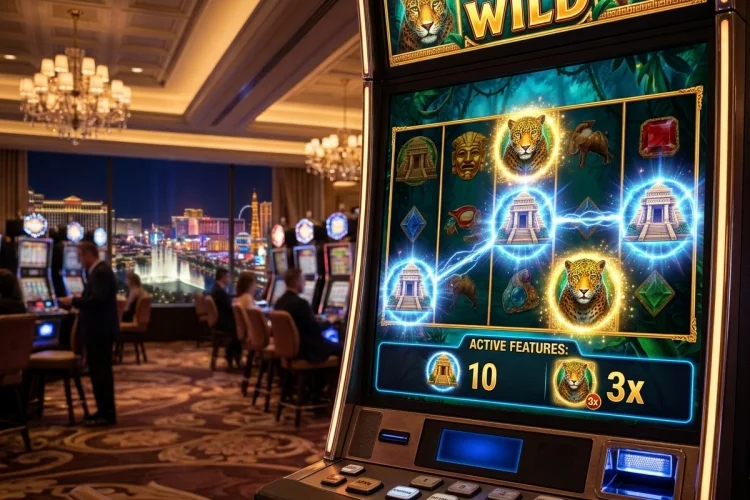
Seeing several special icons land on a slot screen can be exciting, but the result may be confusing when their functions are unclear.
A large “WILD” label may complete a prize, while three themed objects elsewhere on the grid may suddenly launch a free-spin feature.
To interpret these moments correctly, players need to know what Wild and Scatter symbols are. Wilds generally interact with standard combinations by substituting for other paying icons.
Scatters usually operate separately from paylines and activate an award when the required number appears. The challenge is that there is no single rule covering every game.
Some Wilds expand only after contributing to a win. Others remain sticky throughout a bonus or carry multipliers. Scatters may award a fixed number of free spins, increase the reward according to quantity, or reveal a separate prize.
The safest approach is to treat the paytable as the game’s instruction manual. It explains what each symbol does and prevents assumptions based on another slot with different rules.
Start With the Paytable
The paytable lists the ordinary symbols, their potential values, and the combinations needed to create an award. It should also contain a separate explanation for Wilds, Scatters, bonus icons, free spins, and other special features.
Check where winning combinations must begin. Traditional paylines often evaluate matching symbols from the leftmost reel, while cluster-pay or ways-to-win systems may use different patterns.
Next, examine the restrictions. A Wild may substitute for every standard symbol but exclude Scatters and bonus icons. A Scatter may appear anywhere, only on selected reels, or only in the base game.
These small details determine whether a group of special icons has actually created an award.
Reading a Standard Wild
Consider a hypothetical five-reel game with 20 paylines. One payline contains a crown on reel one, a crown on reel two, a Wild on reel three, and unrelated icons afterward.
When the rules allow the Wild to replace the crown, the line is evaluated as three matching crowns. The resulting payout depends on the crown’s listed value and the active stake.
If the Wild itself has a payout, the software may evaluate whether treating it as a Wild combination or a replacement produces the eligible result defined by the game.
This substitution process happens automatically. Players do not manually choose which icon a Wild represents.
Reading an Expanding Wild Feature
An expanding Wild initially occupies one position and then grows according to the game rules. Expansion might occur whenever it lands, only when it contributes to a prize, or only during free spins.
In Wild Water, Wild symbols can appear during both the main game and free spins. During the bonus, a Wild that contributes to a winning combination expands to cover its entire reel.
This example shows why timing matters. A symbol can behave normally in the base game but gain an enhanced function after the free-spin round begins.
Players should check whether expansion occurs before or after combinations are evaluated and whether the enlarged symbol remains for another spin.
Reading a Scatter Trigger
Suppose a game states that three Scatters award ten free spins. If those icons land on reels one, three, and five, they may trigger the feature despite appearing on different rows.
Book of Dead follows this type of structure: three Scatter symbols unlock ten free spins. A normal paying icon is then selected to become a special expanding symbol during the bonus.
Other games require more than three. Gates of Olympus Super Scatter uses four or more standard Scatters to activate its free-spin feature.
The trigger quantity should therefore be checked before every new game.
Retriggers and Additional Scatters
Scatters can sometimes appear during an active free-spin feature. When the required number lands, the game may add more spins, restart the feature, or provide another type of reward.
This process is commonly called a retrigger. The number needed for a retrigger may differ from the initial requirement.
A game might require three Scatters to begin the feature but only two to add extra spins. Another may allow additional Scatters to increase a multiplier rather than extend the round.
The paytable should explain whether retriggers are possible, how many times they can occur, and whether a maximum number of free spins applies.
When Wild and Scatter Functions Overlap
A special icon may serve as both a Wild and a Scatter. In this situation, it can contribute to ordinary combinations while also being counted toward a bonus trigger.
Play’n GO describes Rise of Merlin’s magical orb as a dual Wild-Scatter symbol. It helps form winning combinations and can activate the free-spins feature.
However, dual functionality may depend on the game mode. The icon might count as both in the base game but behave differently during a bonus.
Players should also distinguish dual symbols from separate Wild and Scatter icons that merely share a similar design.
Common Misunderstandings to Avoid
One common mistake is assuming that a Scatter must appear on a payline. In many games it does not, although some titles impose reel-specific or positional conditions.
Another misunderstanding is believing that a Wild always replaces every icon. Jackpot, Scatter, bonus, and collect symbols are frequently excluded from substitution.
Players may also think that almost landing the required Scatters means a bonus is getting closer. In random games, a near miss does not establish that the feature must occur soon.
The UK Gambling Commission’s technical standards require remote random outcomes to be acceptably random and prohibit adaptive behavior that changes probabilities because of previous play.
Use Symbols as Information, Not Predictions
Special symbols explain how a completed spin is evaluated. They should not be treated as a forecasting system.
A screen containing many Wilds does not prove that another large combination will follow. Similarly, repeatedly landing two Scatters does not guarantee that three will appear on the next attempt.
Return to player, volatility, symbol frequency, and feature values work together within the complete mathematical model. A visually frequent Scatter could still require an uncommon combination to activate its main reward.
For that reason, players should base decisions on budgets and game information rather than patterns observed during a short session.
Wilds and Scatters become easier to understand when each result is compared with the paytable. Wild symbols usually replace regular paying icons and may expand, stick, move, or multiply prizes.
Scatter symbols generally work outside ordinary line patterns and can activate free spins, bonus games, direct payouts, or retriggers.
No definition should replace the rules of the individual slot. Trigger quantities, eligible reels, symbol restrictions, and bonus behavior vary considerably between titles.
Before placing a real-money spin, review the paytable and test the game in demo mode where legally available.
Confirm the stake, understand each feature, and establish an affordable stopping point. Knowledge improves clarity, but it does not remove the risk built into casino games.
