
When a roulette dealer says, “No more bets,” it sounds like one simple moment in one simple game.
Behind that announcement, however, several systems may already be working at once: the video broadcast, betting interface, game records, surveillance cameras, table staff, and server infrastructure.
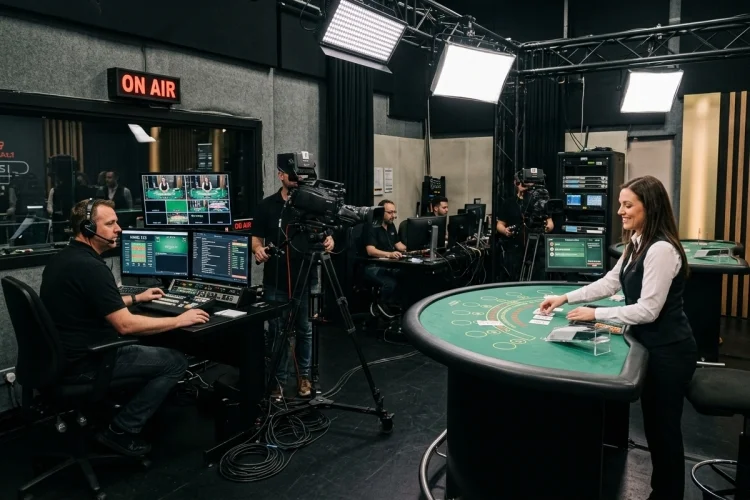
A closer look Behind the Scenes at a Live Casino Table shows how much coordination is needed to make physical casino equipment work online. The visible dealer is only one part of the operation.
Production teams, software systems, supervisors, and security controls quietly help keep each round moving from the studio floor to thousands of screens.
Live Tables Are Part Casino and Part TV Studio
A live casino studio borrows ideas from two very different industries.
From traditional casinos, it takes physical tables, cards, roulette wheels, dealers, and established game procedures.
From television production, it takes cameras, professional lighting, microphones, sets, directors, and broadcast infrastructure.
Evolution describes purpose-built live studios as environments where professional hosts and advanced streaming technology deliver casino tables and game shows across different markets and devices.
Playtech also describes its live casino network as purpose-built studio space using advanced audio-visual technology and trained presenters.
That hybrid structure explains why a professional live table looks so different from someone simply streaming a physical casino through a webcam.
A Dealer Has a Strict Operational Routine
Live dealers may appear relaxed, but a round usually follows a defined process.
A baccarat dealer must handle cards consistently. Blackjack dealers have to manage actions in the correct order. Roulette dealers need to control the betting window, spin procedure, result announcement, and preparation for the next round.
In jurisdictions governed by UK Gambling Commission technical standards, croupiers are expected to be trained and to follow documented procedures and game rules. Refresher training should also be recorded.
Dealers are also presenting to a camera rather than people sitting directly in front of them.
That changes body language.
They need to address remote players, communicate clearly, and maintain the right pace even when thousands of people may be watching from different locations.
It is a surprisingly specialised job.
There May Be Far More Cameras Than You Think
The camera pointed directly at the dealer is only the beginning.
Evolution says the industry evolved from basic webcam broadcasts into multi-camera HD productions with better sound and more carefully designed environments.
Pragmatic Play says its live casino solution uses multiple 4K-quality cameras.
A production may need one angle for the dealer, another for the physical table, and close-ups for cards or a roulette wheel.
Game-show formats can become even more elaborate.
Evolution’s Crazy Time production, for example, combines multi-camera live action with digital technologies including augmented reality and RNG-driven elements.
The result is closer to broadcast entertainment than traditional CCTV footage.
Lighting Is More Technical Than It Looks
Good lighting should almost disappear from the player’s attention.
Cards need to remain readable. Dealer faces should look natural. Reflective equipment cannot create distracting glare, and virtual backgrounds may need perfectly consistent colour.
Evolution has described the technical challenges involved in adapting chroma-key production to smaller live casino spaces. Its teams had to manage shadows and uneven colour so virtual elements could work reliably around the presenter.
This is another reason studios are purpose-built.
A normal room may look perfectly bright to the human eye but perform badly on professional cameras.
The studio needs lighting that works continuously while maintaining consistent image quality across long operating hours.
Player Bets Exist in a Separate Digital Layer
The physical table does not directly know that you tapped $5 on red.
Your bet exists within the casino’s digital platform.
The interface tracks the wager, betting period, balance, table limits, and eventual settlement while the dealer continues the physical game.
Those systems must remain aligned.
If betting is officially closed at the physical table, the online interface cannot continue accepting late wagers. Likewise, the correct result must be attached to the correct betting round.
This creates a constant relationship between physical timing and digital records.
UK Gambling Commission standards require gambling systems under their scope to process and settle wagers in accordance with published game and betting rules.
The flashy betting interface is therefore doing much more than displaying virtual chips.
Physical Results Have to Be Tracked Accurately
When the dealer reveals cards or the roulette ball stops, the outcome has to enter the digital system.
How that happens can vary by game and studio.
Some live casino systems have used tools such as barcoded cards and other forms of table technology to help connect physical actions with the online platform.
Evolution identifies barcoded cards as one of the technical developments introduced as its live casino environments became more advanced.
The important objective is accurate game tracking.
Once the result is captured, software can determine which accepted wagers qualify under the published rules.
The result also becomes part of game history and operational records.
This is one of the least visible but most importent steps in the entire round.
Surveillance and Broadcast Cameras Have Different Jobs
The attractive close-up of a roulette wheel is designed for the player.
Surveillance has a different purpose.
UK live dealer standards require enough video surveillance to record dealer activity and confirm whether procedures and rules were followed. Supervisory staff should also oversee dealer activities and integrity.
That means a studio may contain cameras whose footage players never see.
Security coverage may focus on tables, dealers, equipment, or restricted areas rather than creating cinematic images.
The standards also call for appropriate access controls around secure areas and gambling equipment.
Behind the glamorous studio backdrop is therefore a more practical security environment.
Game Logs Create a Digital Paper Trail
A physical casino can rely heavily on surveillance and table procedures.
An online live casino also generates electronic information.
UK technical guidance says live dealer operations should maintain game logs, with game events collated into statistics that can be analysed for trends involving games, staff, or gaming locations.
This creates an operational record beyond the public video stream.
Logs can help investigate unusual situations, monitor performance, and support auditing.
Imagine a dispute about what occurred several rounds earlier. The operator does not necessarily have to depend on someone’s memory of the table.
The combination of surveillance, transaction records, and game logs can provide a much more detailed picture of the event.
Low Latency Matters Because Betting Is Time Sensitive
A live movie broadcast can tolerate a small delay without changing the story.
Live gambling is different because betting windows and decisions are time-sensitive.
Video must be captured, encoded, distributed, and rendered while digital betting information stays in sync.
Evolution says latency, video synchronization, and sound became increasingly important as live casino systems developed.
Playtech similarly highlights investment in streaming technology and high system availability as part of its live casino platform.
The player’s device and internet connection add another variable.
Someone on a weak connection may see the same table slightly later than another player even though the physical round occurred at exactly the same moment.
Dedicated Tables Can Be Built for One Casino Brand
Not every studio table is visually generic.
Providers can build dedicated areas for specific operators, complete with customised décor, dealers, and table presentation.
Evolution’s earlier PokerStars dedicated environment in Riga, for example, included nine branded live tables with dedicated dealers and a multi-camera studio setup.
This model lets an online casino present what appears to be its own live gaming room even though the production infrastructure belongs to a specialist supplier.
Modern studios may also localise tables by language or market.
That explains why two casinos using the same underlying live provider can still look noticeably different on screen.
The production can be customised without rebuilding the basic technology from scratch.
Technical Problems Need Predefined Procedures
Live casino systems cannot assume that every connection remains perfect.
Network interruptions, software errors, and hardware failures are possible.
UK standards state that gambling systems should have fair procedures for interrupted play. Depending on the situation, systems may need to preserve information, restore an event to its previous state, or void a wager and return the stake.
For multi-stage games, retained information can include cards already dealt and bets placed.
This demonstrates why back-end records matter.
A disconected player may only see that the stream stopped. Behind the scenes, the platform still needs enough information to determine what happened and how the affected round should be handled.
The Dealer Is Only the Visible Tip of the Operation
A live table can involve far more people than appear on screen.
Dealers run the visible game, supervisors oversee operations, production teams maintain cameras and presentation, and technical staff keep streaming and software infrastructure functioning.
Security and compliance teams can also play a role.
Playtech says significant investment in technology, product development, and game-presenter training supports its global live casino operation.
Evolution’s description of its development tells a similar story: as its studios expanded, quality increasingly depended on systems, standards, training, and specialist teams rather than a simple camera-and-table setup.
That is why a professional live table can feel effortless even though the production behind it is anything but simple.
A look Behind the Scenes at a Live Casino Table reveals a mix of casino procedure, television production, software engineering, security, and operational control.
The dealer may be the face of the game, but cameras, supervisors, game tracking, logs, and streaming systems keep each round connected. Before your next live game, notice how much technology quietly works around the physical table.
