
Category: Live Casino

Table GamesLive Casino

Online Blackjack vs Live Dealer Blackjack: Key Differences

Blackjack is available in two major online formats. Traditional online blackjack presents cards through software and animated graphics, while live dealer blackjack streams a professional dealer from a gaming studio.

Both versions use the familiar objective of building a hand closer to 21 than the dealer without going over. However, choosing between Online Blackjack vs Live Dealer Blackjack involves more than visual preference.

The two formats differ in playing speed, atmosphere, table availability, interaction, betting limits, and how game results are produced. Automated blackjack usually gives players greater control over the pace.

A round can begin as soon as the previous hand finishes, without waiting for other participants. Live blackjack is more social and realistic, but the game follows the dealer’s schedule and a shared betting timer.

Neither version guarantees better results. The most suitable format depends on whether a player values convenience and efficiency or prefers a human dealer and a more traditional casino environment.

How Online Blackjack Works

Online blackjack is typically an RNG-based game. The cards and results are generated electronically, while animations show the dealing process on the screen.

Regulated remote game outcomes must be acceptably random. The UK Gambling Commission also prohibits adaptive behavior that changes winning probabilities because of previous payouts or player activity.

Players usually select a stake and press a deal button. After the opening cards appear, the interface provides available actions such as hit, stand, double, split, or surrender.

Some titles allow users to control animation speed or play several hands simultaneously. Evolution’s First Person Blackjack, for example, offers five hand positions and lets users start rounds at their own pace.

How Live Dealer Blackjack Works

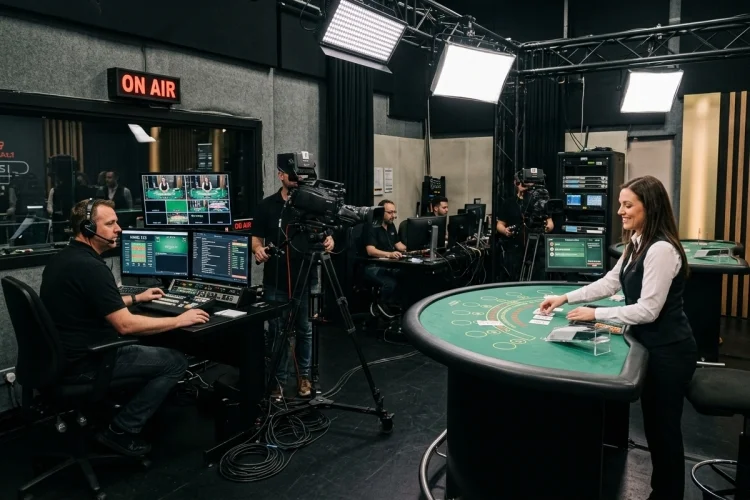
Live dealer blackjack is streamed from a studio containing real tables, physical cards, cameras, lighting, and professional dealers. Players use digital chips, but they watch the dealer handle the actual cards in real time.

Licensed live dealer studios in Great Britain must operate fairly and be independently auditable. Regulatory guidance covers trained dealers, commercial-quality equipment, surveillance, access controls, and maintained records.

Each round normally includes a fixed betting period. Once betting closes, the dealer distributes the cards and manages player decisions according to the table procedure.

The result is more similar to visiting a physical casino, although the player still interacts through a screen.

Speed and Convenience

Automated blackjack is generally more convenient for short sessions. Players do not need to wait for an available seat, dealer announcements, card handling, or decisions from other table participants.

A new RNG round can normally begin immediately after settlement. This creates a faster experience but may also lead to more wagers being placed within a limited period.

Standard live tables move more slowly because the dealer must physically manage each stage. Speed variants reduce these delays.

Evolution’s Speed Blackjack allows participants to make decisions simultaneously, with cards dealt according to the order in which decisions are submitted.

A faster format does not improve the odds. It simply increases the number of potential rounds that can be completed during a session.

Atmosphere and Player Interaction

Online blackjack emphasizes privacy and efficiency. There is no public table conversation, and players can study the controls without feeling that others are waiting for them.

This format may be comfortable for beginners who are still learning hand values and available actions. An automated game also avoids concerns about table etiquette.

Live dealer blackjack offers stronger human interaction. Players can watch the dealer, follow spoken announcements, and sometimes communicate through moderated chat.

However, the countdown can create pressure when a player is unfamiliar with basic strategy. Observing several rounds before betting can make the timing and interface easier to understand.

Seats, Limits, and Game Availability

RNG blackjack does not usually have physical seat restrictions. A player can open a game whenever the platform is operating, provided the title is legally available in that location.

Traditional live tables may offer a limited number of seats. When every position is occupied, players may need to wait or choose another table.

Scalable formats address this issue. Evolution’s Infinite Blackjack offers unlimited seats by giving participants a shared opening hand and allowing each player to make independent decisions afterward.

Betting limits also vary. Automated games often provide lower minimum stakes, while standard or VIP live tables may require larger wagers. The specific limits should always be checked before joining.

Rules, Payouts, and Side Bets

The main blackjack objective is similar in both formats, but individual rules may differ. Important details include deck count, whether the dealer hits soft 17, blackjack payouts, surrender availability, and doubling restrictions.

The UK Gambling Commission requires remote game descriptions to provide enough information for customers to understand how a game works, its prizes, and their likelihood of winning.

Both formats may include Perfect Pairs, 21+3, or other side bets. Evolution’s First Person Blackjack and several live variants offer these optional wagers.

Side bets should be evaluated separately from the main hand. They use different paytables and generally increase the total amount risked during each round.

Fairness and Security

Neither RNG nor live dealer blackjack should be selected solely because it appears more trustworthy. The operator’s licence, testing standards, security procedures, and transparency are more important than the presentation style.

Licensed RNG games are subject to random-outcome requirements and game testing. Live studios must use auditable procedures designed to protect the integrity of physical dealing.

Players should verify the operator through the relevant regulator’s official register. They should also review transaction records and report any unexplained settlement to customer support.

A realistic video stream does not replace regulation, just as polished animation does not prove that an automated game is fair.

Online Blackjack vs Live Dealer Blackjack offers the same basic card-game objective through two different experiences. RNG blackjack provides faster rounds, private play, wide availability, and greater control over timing.

Live dealer tables offer physical cards, human interaction, and a more authentic casino atmosphere. The better option depends on personal priorities.

Beginners who need time to understand decisions may prefer automated blackjack, while players seeking social entertainment may enjoy a standard live table.

Before playing, compare table rules, blackjack payouts, minimum bets, and available safety tools.

Choose a licensed operator, use a strategy chart that matches the rules, and establish firm spending and session limits before the first hand.

Live Casino

How Live Dealer Baccarat Works Behind the Screen

A live baccarat table may appear simple on the screen: a dealer sits behind a table, cards are drawn, totals appear, and winnings are credited.

Behind that smooth presentation is a coordinated system connecting physical casino equipment with video broadcasting, account software, wagering controls, and game records.

Understanding how live dealer baccarat works behind the screen can help beginners distinguish it from automated baccarat. In an RNG game, software generates and displays the entire round.

At a live table, physical cards and a trained dealer determine the result while technology communicates every action to online players.

The interface must accept wagers within a limited period, connect them to the correct game round, display card values, calculate payouts, and maintain a record of the transaction.

Cameras and surveillance also provide several views of the dealing process.

Although this technology creates an immersive experience, players should still check licensing, rules, table limits, and responsible gambling controls. A polished video stream alone does not prove that a platform is trustworthy.

Inside a Live Baccarat Studio

A typical live casino studio contains multiple gaming tables arranged in controlled areas. Each table may have professional lighting, several cameras, a card shoe, dealing equipment, microphones, and monitoring systems.

The dealer operates the physical part of the game. Studio staff may also supervise dealing procedures, equipment integrity, card handling, and technical performance.

UK Gambling Commission standards state that licensed live dealer operations must be fair and independently auditable. They call for commercial casino-quality equipment, trained croupiers, surveillance, secure access, and maintained game logs.

These controls help create evidence of what happened if a dealing or settlement dispute must be reviewed.

How the Video Stream Reaches Players

The table is filmed in real time and delivered through the casino’s website or application. One camera may show the dealer, while another provides a close view of the cards.

The broadcast is combined with a digital layer containing betting areas, chip values, hand totals, recent results, chat, and a countdown. The player interacts with this layer rather than physically touching the cards.

Video quality can depend on the device, internet connection, and stream settings. A brief visual delay does not usually change a wager that was already accepted by the system.

Players should rely on the confirmed bet display and account history rather than assuming that every click was registered before the countdown ended.

The Betting Window and Round Identification

Each baccarat round has a distinct betting period. Players select Player, Banker, Tie, or an available side bet while the table remains open.

When the countdown reaches zero, the software closes betting and associates all accepted wagers with that specific round. The dealer then begins or completes the dealing process.

This separation prevents customers from placing a new wager after learning information that should not be available during betting. It also makes it possible to track the round in transaction records.

Buttons such as repeat, double, and clear can speed up wagering, but they should be used carefully. Repeating a previous selection may also repeat all side bets and not only the main Player or Banker stake.

Physical Cards Determine the Outcome

Live baccarat uses real cards from a shoe. Traditional games frequently use multiple decks, and the dealer distributes cards to the Player and Banker hands according to documented rules.

The objective is to identify the hand closest to nine. Aces count as one, cards two through nine use their face values, and tens or picture cards count as zero. Only the last digit of a total is used.

The UK Gambling Commission notes that live dealer games use physical equipment, with fairness influenced by card shuffling, dealing procedures, equipment controls, and ongoing integrity measures.

This differs from fully automated baccarat, where a random number generator determines the electronic result.

How Cards Are Read and Displayed

After the dealer reveals a card, the system identifies its rank and updates the relevant hand total. Some studios use card-reading technology, while the video feed allows the cards to be visually confirmed.

The interface may show the current total beside each hand. If another card is required, the dealer follows the fixed third-card table rather than making a personal choice.

Player draws on totals from zero through five and stands on six or seven. The Banker’s action may depend on its total and the value of the Player’s third card. Natural totals of eight or nine normally stop further drawing.

After all required cards have been dealt, the software compares the final values and identifies the result.

Automatic Settlement of Wagers

Once the result is confirmed, the platform removes losing stakes, returns pushed bets, and credits eligible winnings. Settlement should correspond to the paytable displayed for that specific game.

Standard Player bets normally pay 1:1. Traditional Banker bets commonly pay 1:1 minus a 5% commission, while Tie and side-bet payouts vary by table.

No Commission Baccarat modifies this arrangement. In a common version, most Banker wins do not incur the usual commission, but a Banker win with a total of six pays only half the original wager.

Players should check whether they entered standard, no-commission, or another modified table before placing a bet.

Game History, Roads, and Statistics

Live baccarat interfaces commonly display previous outcomes in visual charts called roads. The Big Road, Bead Plate, Big Eye Boy, Small Road, and Cockroach Pig may organize the history in different patterns.

These displays can make streaks and alternations easier to see. They do not change the fixed drawing rules or establish what the next result must be.

Pragmatic Play’s Speed Baccarat includes live statistics and support for five traditional baccarat roads. The information is descriptive rather than predictive.

Personal transaction history is more useful for confirming stakes and settlements. When the stream disconnects, players should check whether the round was accepted and completed before submitting another wager.

Standard, Speed, and Enhanced Broadcasts

Standard tables provide a moderate betting window and regular dealing pace. They are generally easier for beginners because there is more time to review the total stake.

Speed variants reduce waiting and accelerate the dealing process. Evolution states that its Speed Baccarat completes a round in approximately 27 seconds, compared with around 48 seconds for its standard version.

Enhanced baccarat may add card multipliers, insurance options, or special side bets. Lightning Baccarat, for example, selects random card ranks and assigns possible payout multipliers, while charging an additional fee on wagers.

Modified formats require careful reading because standard payout assumptions may no longer apply.

Staying Secure and in Control

Use live baccarat only through an operator legally authorized in the relevant jurisdiction. Confirm the licence through the regulator’s official database rather than trusting an image in the website footer.

Review the betting limits before entering. A visually identical table may have a significantly different minimum or maximum stake.

Set an account deposit limit and a session reminder where available. UK technical standards require easily accessible reality checks that show elapsed playing time during remote gaming sessions.

Avoid sharing account details in dealer chat. Payment, verification, and settlement questions should be directed to the operator’s official support service.

Live dealer baccarat connects a physical table with a digital wagering system. Real cards and trained dealers produce the outcome, while cameras, card-reading technology, account software, and game logs deliver and document each round.

The betting interface accepts wagers before the deadline, displays hand values, and settles results according to the table’s paytable. Studio controls, surveillance, trained personnel, and independent auditing are important signs of a regulated operation.

Before playing, identify whether the table uses standard commission, no commission, speed rules, or enhanced features. Check the minimum stake and transaction history, then set firm spending and time limits.

Choose a licensed platform and treat the live presentation as entertainment, not evidence that losses can be predicted or recovered.

Live Casino

A Beginner’s Guide to Live Roulette: Rules, Bets, and Tips

Live roulette combines the convenience of online gaming with the atmosphere of a traditional casino table.

Instead of watching a digitally animated wheel, players see a real dealer spin a physical roulette wheel through a live video stream.

For newcomers, the table may initially look complicated. It contains dozens of numbered spaces, betting sections, chip values, statistics, and countdown timers.

However, the basic objective is easy to understand: place a wager on where the ball will land after the wheel stops spinning.

This Beginner’s Guide to Live Roulette explains the complete process, including wheel layouts, betting categories, payouts, table procedures, and practical playing tips.

It also examines the difference between European and American roulette, which can significantly affect the mathematical house advantage.

Live roulette remains a game of chance. Learning its rules can help players make informed decisions, but no betting pattern can predict the next winning number or guarantee a profit.

What Is Live Roulette?

Live roulette is an online casino game streamed from a professional studio or participating land-based venue. A real dealer manages the wheel, announces the result, and controls the pace of each round.

Players place digital chips through the betting interface while watching the action in real time. Some tables also provide chat functions, betting statistics, favorite-bet settings, and different camera angles.

Regulated live dealer studios must follow technical and operational standards. The UK Gambling Commission requires live dealer operations under its jurisdiction to be fair and independently auditable.

How a Live Roulette Round Works

Each round begins with a betting period. A countdown timer shows how long players have to select chip values and place wagers on the virtual table.

The dealer then spins the wheel and launches a small ball in the opposite direction. Betting closes before the ball settles into one of the numbered pockets.

Once the result is confirmed, the interface automatically identifies winning bets and credits eligible payouts. Losing chips are removed, and a new betting period begins shortly afterward.

Players do not need to calculate every result manually. However, understanding why a wager won or lost makes it easier to review the betting history and follow the table.

Understanding the Roulette Wheel

European roulette uses 37 pockets. These include numbers 1 through 36 and one green zero.

American roulette adds a second green pocket marked 00, creating 38 possible outcomes. The additional zero increases the casino’s mathematical advantage on most standard wagers.

Single-zero roulette generally has a house edge of approximately 2.70%, while double-zero roulette usually has a house edge of 5.26%. For that reason, European roulette normally offers more favorable standard odds for players than the American version.

The red and black numbers are not arranged sequentially around the wheel. Their order is designed to distribute colors, high and low numbers, and odd and even values around the wheel.

Inside Bets Explained

Inside bets are placed directly on numbers or on the lines separating several numbered spaces. They cover fewer possible outcomes but offer larger payouts when successful.

A straight-up bet covers one number and normally pays 35 to 1. A split covers two adjoining numbers and pays 17 to 1, while a street covers a horizontal row of three numbers and pays 11 to 1.

A corner bet covers four numbers that meet at one point and typically pays 8 to 1. A six-line bet covers two neighboring rows, producing six possible winning numbers and a lower payout.

These wagers create the possibility of larger returns from a single result. However, their probability of winning is lower because they cover only a small portion of the wheel.

Outside Bets Explained

Outside bets appear around the main number grid. They cover larger groups of outcomes and therefore win more frequently than single-number wagers, although their payouts are smaller.

Red or black, odd or even, and low or high bets normally pay even money. The low section covers numbers 1-18, while the high section covers 19-36. Zero and double zero are not included in these groups.

Dozen bets divide the numbers into 1-12, 13-24, and 25-36. Column bets cover one of the three vertical columns on the layout. Both normally pay 2 to 1.

Outside bets may feel more suitable for beginners because they are easy to recognize. Nevertheless, they can still lose, especially when the ball lands on a green zero.

Payouts Do Not Equal True Odds

A 35-to-1 payout on a straight-up number may appear generous, but European roulette contains 37 possible pockets. A fair payout without a house advantage would therefore be 36 to 1.

The difference between the true probability and the casino payout creates the house edge. The same principle applies to most other standard bets.

Changing from inside to outside wagers changes the frequency and size of potential wins, but it does not normally remove the mathematical disadvantage.

Betting on more numbers may produce more winning rounds while reducing the payout received for each successful result.

Previous outcomes also do not determine the next spin. A long sequence of red numbers does not make black certain to appear next.

Practical Tips for a First Live Session

Begin with a standard European table offering limits that suit your budget. Avoid selecting a table only because it has dramatic multipliers, rapid rounds, or unusually high maximum bets.

Watch several rounds before wagering. This allows you to become familiar with the countdown, chip controls, dealer announcements, and result display.

Use small, consistent stakes and decide on a total loss limit before the session starts. Do not increase the bet simply because several previous wagers were unsuccessful.

Check the help menu for table-specific rules. Roulette variants may use different betting times, minimum wagers, special payouts, or bonus features, even when their layouts look similar.

Live roulette is straightforward once its table and betting categories are understood. Players choose one or more potential outcomes, the dealer spins a physical wheel, and payouts are calculated after the ball settles.

Inside bets cover fewer numbers and provide larger potential rewards. Outside wagers cover broader groups but pay less. European roulette is generally more favorable than American roulette because it contains only one zero.

Before joining a table, review its rules, minimum stake, wheel type, and betting timer. Start with an affordable budget and treat every wager as entertainment spending.

Open a low-limit European table, observe a few rounds, and practise identifying the bets before committing real money.