
Why Slot Results Cannot Be Predicted from Previous Spins and Streaks

Why Slot Results Cannot Be Predicted from Previous Spins and Streaks

Watch a slot long enough and patterns seem to appear everywhere. Three wins arrive close together, a bonus disappears for dozens of rounds, or the same high-value symbol repeatedly lands just outside the payline.

These sequences can make a game feel readable. In reality, understanding Why Slot Results Cannot Be Predicted from Previous Spins means separating patterns we can see from probabilities that actually affect the next round.

In standard RNG-based play, past results do not tell the game what to produce next, so a streak is history rather than a reliable forecasting signal.

Random Does Not Mean Perfectly Mixed

One reason slot patterns seem suspicious is that people often have the wrong picture of randomness.

We imagine random results should look evenly distributed. A win should appear, then some losses, another win, perhaps a bonus, and so on.

Real randomness can look much messier.

Imagine flipping a coin 100 times. A perfectly alternating sequence of heads, tails, heads, tails would actually look suspicious. A real random sequence is likely to include clusters such as four heads followed by several tails.

Slot outcomes can create similar patterns.

Several prizes may appear within a short period. Long stretches may contain nothing significant. Those clusters do not necessarily reveal hidden cycles; they are normal occurences within probabilistic systems.

Why a “Cold” Slot Is Not Automatically Due to Pay

Suppose someone watches a slot produce 40 spins without a major prize.

The instinctive reaction may be, “Surely it has to pay soon.”

But consider a fictional event with a 2% probability on each independent round. That means each new qualifying spin has a 2% chance under our simplified example.

Forty previous misses do not convert the next spin into a guaranteed win.

This is where intuition clashes with probability. People often expect randomness to correct itself quickly.

Over enormous samples, observed frequencies may move closer to theoretical probabilities. But that does not mean the process has to balance itself within a player’s next five, ten, or 100 spins.

A cold-looking session can continue to look cold.

A “Hot” Slot Is Not Predictive Either

The opposite belief is equally misleading.

Suppose a slot has just awarded several prizes. Some players may assume it has entered a hot period and keep playing because they expect the trend to continue.

Others believe the exact opposite – that the slot has “used up” its wins and must now become cold.

Both ideas attempt to use previous results as information about a future random outcome.

Neither works when game rounds are independent.

The next result comes from the game’s mathematical probability model, not from a requirement to continue or reverse the recent trend.

A winning streak can be exciting, but statistically it is a description of past events rather than a reliable map of future ones.

Why the RNG Does Not Remember Your Session

Online slots commonly use a Random Number Generator to produce unpredictable values used in determining game outcomes.

The RNG does not need to remember that you personally lost ten previous rounds and compensate you on the eleventh.

Technical standards in regulated markets specifically address this issue. The UK Gambling Commission requires random outcomes to be unpredictable and says games must not use adaptive behaviour that changes probabilities based on previous payouts or the amount won or lost.

This matters because myths often describe online slots as if they have a hidden emotional memory.

“The machine took enough money.”

“It has already paid too much.”

“It knows I increased my stake.”

These explanations may feel intuitive after a dramatic session, but they are not how compliant independent RNG outcomes are intended to work.

Near-Misses Are Visually Powerful but Statistically Misleading

Imagine needing three special symbols to trigger a feature.

Two appear, while the third lands just above the visible winning position.

That feels incredibly close.

Compare it with a spin containing none of the required symbols. Emotionally, the two-symbol result seems much more important.

But unless the game’s documented mechanics say otherwise, a near-miss does not store progress toward the next feature.

The next spin is not rewarded for nearly winning previously.

This distinction matters because visual presentation can create a sense of momentum that does not exist mathematically.

A symbol landing one position away might look more promissing, yet it cannot tell you which random outcome will be generated next.

Spin Histories Describe the Past, Not the Future

Casino interfaces sometimes display previous results.

That information can be interesting, but it should not automatically be treated as predictive data.

Imagine a visible history showing:

Loss, loss, loss, small win, loss, loss, bonus.

What pattern comes next?

There is no reliable answer based only on that sequence.

You could invent many stories around it. Perhaps bonuses appear every seven rounds. Maybe the slot becomes generous after five losses. Perhaps another bonus will come quickly because the game is hot.

The problem is that these stories are created after seeing the data.

Random sequences allow humans to find apparent patterns almost anywhere. The difficult part is proving that those patterns have genuine predictive power on future independent rounds.

In regulated random slots, historical outcomes by themselves do not provide that advantage.

RTP Cannot Be Used as a Personal Payback Meter

RTP creates another popular prediction mistake.

A player might know that a game has a theoretical 96% RTP, spend $200 while receiving only $100 back, and conclude that the slot must soon return more money to reach 96%.

It does not work that way.

Theoretical RTP is calculated over a huge number of game rounds, not one person’s session.

The UK Gambling Commission explains that actual return can vary significantly over shorter periods. Volatility further influences how widely results may move around the theoretical expectation.

A high-volatility game can be particularly dramatic because more of its theoretical payout may be concentrated in less frequent prizes.

Your personal balance is therefore not a gauge showing how far the slot is behind its RTP obligation.

There is no individual “refund point” waiting ahead.

Volatility Explains Swings Without Predicting Them

Volatility is useful for understanding why some slots produce more dramatic sequences than others.

Low-volatility games generally concentrate more payout value in smaller, more frequent prizes. High-volatility games can place greater weight on larger but less frequent outcomes.

This can explain the character of a game without revealing the next result.

For example, knowing that a slot is highly volatile can tell you that long prize-free stretches may be more consistent with its mathematical design.

It does not mean that a big prize becomes increasingly likely as the losing streak grows.

Volatility describes the distribution of outcomes. It is not a timer.

Confusing these two concepts can lead players to continue far longer than intended because they believe the “big one” must be approaching.

Can Anyone Find a Pattern That Beats an RNG?

If previous results do not predict future independent spins, recording hundreds of outcomes does not create a secret forecasting system.

A spreadsheet can show frequencies, streak lengths, average returns, or how often certain visible events occurred in your sample.

That may be interesting statistically, but descriptive data and predictive data are not the same thing.

A small sample can also be especially decieving. A rare symbol appearing five times in 500 rounds does not establish a dependable cycle.

Independent testing laboratories evaluate gambling systems using much larger samples and technical methods rather than trying to identify simplistic streak patterns.

Regulated game testing can include examination of RNG implementation, theoretical game mathematics, and whether outcomes conform to required standards.

The Important Exception: Published Stateful Features

Not every modern slot resets every visible feature after each round.

Some games include collection meters, persistent symbols, guaranteed features, or progress mechanics that explicitly carry between spins.

Suppose the game rules say that collecting ten tokens activates a bonus and your meter shows nine. Obviously, the existing meter matters.

That does not contradict random outcome principles.

You are responding to a documented game state rather than claiming that five previous losses make the RNG more likely to produce a win.

Players should always check the rules because stateful mechanics can affect available outcomes or features.

The key distinction is simple: published game mechanics can contain memory; independent random results do not become predictible merely because a streak occurred.

The Practical Lesson: Do Not Chase a Pattern

Believing that previous spins predict the future can influence betting behaviour.

A player who thinks a bonus is overdue may raise the stake. Someone who believes a machine is hot may extend a session beyond the original budget.

Neither decision changes the underlying randomness.

If you decide to play, a more practical approach is to set an entertainment budget before starting and choose a stake that fits it.

When the predetermined limit is reached, a streak should not become a reason to keep chasing.

Randomness means the next spin could win or lose, not that the game owes either outcome.

The reason Why Slot Results Cannot Be Predicted from Previous Spins is straightforward: independent RNG outcomes do not become more predictable because of streaks, near-misses, or past losses.

RTP and volatility can describe a game’s mathematics, but neither forecasts the next round.

Use game statistics to understand risk, not to hunt imaginary patterns. Set clear limits and treat every new independent spin as uncertain.

Fixed Paylines vs Adjustable Paylines: Which Slot System Does What?

Fixed Paylines vs Adjustable Paylines: Which Slot System Does What?

The number of paylines printed on a slot game can look like a simple technical detail, but it can tell you quite a lot about how wins and wagers are structured.

What matters even more is whether those lines are permanently active or can be switched on and off.

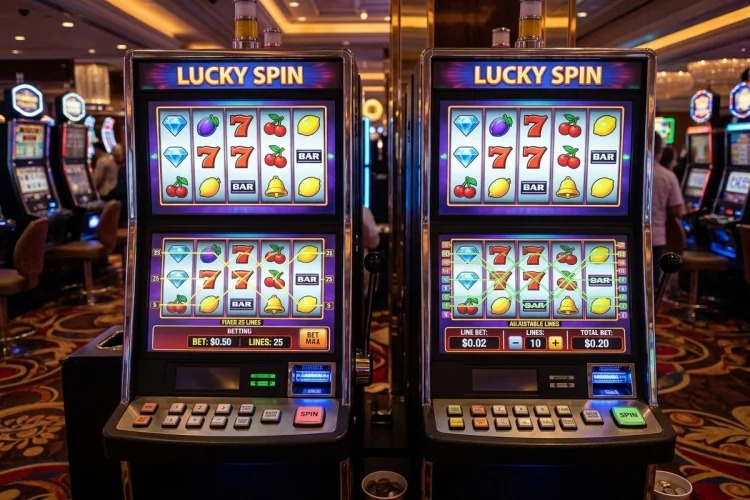
The debate around Fixed Paylines vs Adjustable Paylines is really about two different approaches to slot design. One keeps every available winning pattern active on every spin.

The other gives the player some control over line coverage and often the overall stake. Neither system predicts results, but they create noticeably different gameplay experiences.

Why Paylines Exist in the First Place

Paylines tell a slot which symbol positions should be evaluated together for a potential win.

On an old three-reel machine, there might be only one horizontal line through the middle.

Modern video slots can have five, ten, twenty, fifty, or many more patterns. These lines can travel horizontally, diagonally, or through zigzag formations.

Evolution defines paylines as winning arrangements of symbols across reels and notes that they can take several geometric forms.

The number of lines is therefore not the number of rows visible on screen.

A standard five-reel, three-row slot can still contain dozens of different winning paths through the same 15 symbol positions.

Fixed Paylines Keep Full Line Coverage Active

A fixed-payline game activates every line automatically.

If the game has 25 lines, every one of those 25 lines participates in every spin.

You cannot normally switch individual lines off simply to reduce the wager.

The practical benefit is simplicity.

There is no need to wonder whether a symbol combination landed on an inactive line. If it matches one of the game’s valid paylines and satisfies the paytable requirements, the game evaluates it.

Many modern games simplify things even further by allowing players to choose a total stake rather than manually calculating coins per line.

This makes the betting interface cleaner, especially on mobile screens.

Adjustable Paylines Give More Betting Control

Selectable lines work differently.

PokerStars explains that while some slots have fixed paylines, other titles let players choose how many paylines are active.

Imagine a 20-line game that allows you to activate between one and twenty lines.

You might decide to play five lines at $0.10 per line for a total stake of $0.50.

Activating all twenty at the same $0.10 line stake would cost $2 per spin.

That gives the player more control over the wager structure.

However, it also introduces another decision: how much of the reel grid should actually be covered?

The ability to lower line count should not be confused with changing the underlying randomness of the reels.

More Active Lines Means More Coverage

The most obvious difference appears after the reels stop.

Suppose a matching combination lands on line 12.

If you activated all twenty lines, it can be evaluated as a potential winning combination. If you activated only lines one through ten, line 12 is outside your active coverage.

This is why fewer paylines can produce situations where matching symbols appear but no line prize is awarded.

PokerStars’ slot rules state that the aim is to match symbols along active paylines and that individual game paytables define the required combinations.

More active lines therefore provide greater line coverage.

But they may also increase the total amount wagered.

Coverage and cost need to be considered together.

How Paylines Affect Hit Frequency

Hit frequency generally refers to how often a game produces some form of winning result.

In a selectable-line game, activating more lines gives the slot more active routes on which line combinations can qualify.

That can make winning events appear more frequent compared with playing only a small part of the available line set, all else being equal.

But this does not mean you have discovered an advantage.

If the total wager rises when more lines are activated, you are paying for that additional coverage.

A $0.20 return on a $1 spin is technically a winning event on the reels, but financially the spin still resulted in a net loss of $0.80.

This difference between a line win and an actual profit on the spin is extreemly important when judging how “often” a slot seems to pay.

Payline Count Does Not Tell You RTP

A slot with 50 paylines is not automatically better than one with ten.

Likewise, a fixed-line game is not automatically more generous than an adjustable-line game.

Return to Player depends on the complete mathematical model.

The UK Gambling Commission explains that RTP represents a theoretical percentage measured over a large number of games, not a prediction of what one person will receive from a short session.

Symbol probabilities, paytable values, wilds, scatters, free spins, jackpots, and other features all contribute to a game’s mathematics.

The visible line count is only one piece of that system.

When RTP is provided, read the official game information rather than estimating it from the number of active paylines.

Payline Structure and Volatility Are Different Concepts

Another common mistake is assuming that more paylines automatically mean lower volatility.

Volatility describes the pattern in which potential payouts are distributed. A game can have dozens of active lines and still be designed around relatively infrequent large payouts.

Another game may have fewer paylines but produce modest awards more regularly.

Payline configuration influences how combinations are evaluated, while volatility relates to the broader payout distribution.

The two may interact within a game’s mathematical model, but one cannot be reliably determined from the other.

This is another reason why comparing games by line count alone gives an incomplete picture.

Bonus Symbols May Follow Different Rules

Not every important symbol needs to land on a traditional payline.

Scatter symbols often use different rules.

PokerStars explains that scatter symbols can trigger payouts or features when they appear across the reels, although the exact requirements depend on the individual game.

Some games may also tie bonus features to active paylines.

For example, the published rules for Tiki Island state that some bonus symbols must appear on active paylines to trigger particular features.

Its rules also specify that between one and twenty paylines can be played and that total bet is calculated from paylines multiplied by coin size.

This demonstrates why generic assumptions can cause problems.

Always check whether special features depend on line selection before reducing the number of active lines.

Modern Slots Are Moving Beyond Traditional Lines

Paylines are no longer the only way to calculate slot wins.

Ways-to-win systems, Megaways, cluster pays, and scatter-pay mechanics have become common alternatives.

PokerStars notes that paylines have evolved significantly from the original single horizontal winning line, while modern designs can use many different payout arrangements.

Megaways takes this further by changing the number of symbols visible on the reels and therefore changing the number of possible winning ways between spins. Evolution notes that many Megaways titles can offer up to 117,649 ways to win.

These “ways” are not simply adjustable paylines under another name.

They use a diffrent method for determining qualifying combinations.

Which Details Matter More Than the Line Count?

The headline payline number is only a starting point.

Before playing, check the total cost per spin, minimum and maximum stake, paytable, RTP, wild rules, scatter conditions, bonus triggers, and any available volatility information.

For adjustable games, confirm how changing the number of active lines alters the total wager.

Also check whether certain features require maximum lines or specific betting conditions.

A slot with fewer lines may cost more per spin than another game with many fixed paylines.

The actual wager is more important to bankroll management than the number printed beside the word “lines.”

That is a simple but very usefull distinction.

Fixed or Adjustable Does Not Predict the Next Spin

Neither payline structure gives information about what the next random outcome will be.

Changing from ten lines to twenty does not mean the reels are suddenly “due” to create a winning symbol pattern. Similarly, reducing the number of active lines does not make the unused lines more likely to hit.

Random game outcomes should not be interpreted using previous wins and losses as a prediction system.

The UK Gambling Commission notes that for random gaming machines, the chance of winning the current game is not affected by whether previous games were wins or losses.

Payline selection changes coverage and potentially stake size, not what past results mean.

The key difference in Fixed Paylines vs Adjustable Paylines is straightforward: fixed games keep every line active, while adjustable games let you control line coverage.

That choice can influence total stake and how many patterns qualify for wins, but it does not remove the game’s mathematical edge. Check the paytable and total wager carefully before choosing how many lines to activate.

Understanding Slot Symbols, Multipliers, and Bonus Features

Understanding Slot Symbols, Multipliers, and Bonus Features

Modern online slots contain much more than spinning reels and matching pictures.

A single game may include standard paying icons, wild substitutions, scatter triggers, increasing multipliers, free spins, respins, expanding grids, and several bonus rounds.

Without reading the rules, it can be difficult to understand why one combination pays while another does not. Understanding slot symbols, multipliers, and bonus features helps players interpret what appears on the screen.

Regular symbols usually create the basic winning combinations, while special icons can substitute, activate features, or modify the value of a payout.

However, the same symbol does not behave identically in every game. A wild may expand across a reel in one title and remain locked during free spins in another.

A scatter might award an immediate prize, trigger a bonus round, or perform both functions.

The most reliable source is always the game’s information panel. It explains the paytable, winning system, feature triggers, stake calculation, and special-symbol rules.

Regular Slot Symbols

Regular symbols form the standard payouts in most slot games. They are commonly divided into lower-value and higher-value categories.

Low-paying icons often use familiar card ranks such as ten, jack, queen, king, and ace. Premium symbols are generally connected to the game’s theme and normally offer larger paytable values.

A winning combination may need to follow a fixed payline, appear across adjacent reels, or form a connected cluster.

The required number of matching symbols also varies. Some games begin paying from two premium icons, while others require at least three.

Players should not assume that a visually impressive symbol is automatically the most valuable. The paytable shows its actual payout and the minimum number needed.

How Wild Symbols Work

A wild usually substitutes for selected regular symbols to help complete a winning combination. It often cannot replace scatters, bonus icons, or jackpot symbols.

For example, Play’n GO explains that the wild in Wild Blood substitutes for other reel symbols except scatter and bonus symbols.

In that game, a wild landing on the third reel can also expand to cover the full reel. This demonstrates how one symbol may combine substitution with an additional feature.

Other common variations include sticky wilds, moving wilds, stacked wilds, spreading wilds, and random wilds. Sticky wilds remain in place for several spins, while expanding versions grow to cover additional positions.

A wild does not always guarantee a prize. It must still participate in a combination that satisfies the game’s winning rules.

What Scatter Symbols Do

Scatters normally operate independently from standard paylines. They may pay when enough appear anywhere on the reels, although the exact requirement depends on the title.

Play’n GO describes scatters as symbols commonly used to unlock features such as bonus rounds and free spins. Their appearance and function are generally connected to the theme of the game.

A slot may require three scatters to activate ten free spins, while another may award a different number according to whether three, four, or five land. Pragmatic Play’s Sweet Bonanza, for example, uses four to six scatters to trigger ten free spins.

Scatters can sometimes provide direct payouts as well as feature access. Players should check whether the award is based on the total bet, a fixed credit value, or another calculation.

Understanding Slot Multipliers

A multiplier increases an eligible payout by a stated factor. A 3x multiplier applied to a 10-credit win produces 30 credits.

Some multipliers are attached to wild symbols. Others appear as separate icons, increase after each cascade, or apply to every prize during a bonus round.

In Sweet Bonanza, multiplier symbols can appear during free spins with values from 2x to 100x. When several land during the same tumbling sequence, their values are added and applied to the qualifying win.

Multipliers may be additive or multiplicative. Two values of 2x and 3x might produce a combined 5x in one game but 6x in another. Never assume how they interact without checking the rules.

Free Spins and Respins

Free spins provide additional rounds without deducting the normal wager again. The stake used to trigger the feature usually determines the value of prizes during the free-spin session.

The bonus may include enhanced mechanics such as sticky wilds, higher multipliers, upgraded symbols, or additional reel positions.

NetEnt’s Wild Worlds activates eight free spins with three scatters and offers different feature variations involving spreading, heavy, or random wilds.

A respin is different. It repeats or partially repeats a reel result, often while locking selected symbols in place. NetEnt’s Starburst uses an expanding wild that fills a reel and activates a respin.

Free spins and respins are not automatically profitable. Their value depends on the game mathematics and the symbols that appear.

Pick-and-Click and Interactive Bonuses

Some slots include interactive bonus rounds in which players select objects to reveal cash prizes, multipliers, free spins, or feature upgrades.

Although the player chooses an object, the result is generally governed by the game’s programmed rules. Choosing the first chest rather than the last one does not necessarily create a strategic advantage.

Other bonus structures include prize wheels, collection meters, mystery symbols, jackpot selections, and hold-and-win rounds. NetEnt’s Wild Wild West: The Great Train Heist includes a pick-and-click feature alongside several wild variations.

Players should review how the feature ends, whether prizes are added together, and whether collecting a particular number of items unlocks a higher level.

Read the Paytable Before Playing

The paytable explains which symbols pay, the required combinations, and how special features operate. It should also describe the winning direction, reel layout, RTP, volatility, and maximum possible award where relevant.

The UK Gambling Commission requires licensed remote games to provide sufficient information about rules, prizes, and the likelihood of winning so customers can make informed decisions.

Pay particular attention to whether values are displayed as credits, total-bet multipliers, or line-bet multipliers. A number such as “20” can represent different monetary amounts depending on the stake system.

Understanding slot symbols, multipliers, and bonus features makes modern games easier to follow.

Regular icons create basic payouts, wilds substitute for eligible symbols, scatters commonly activate features, and multipliers increase qualifying awards.

Free spins, respins, pick bonuses, and expanding grids then add further variations.

No symbol or bonus guarantees a positive result. Every title uses its own paytable and mathematical model, so rules from one slot should not be applied automatically to another.

Before playing, open the information panel and examine the winning system, symbol values, bonus triggers, multiplier rules, RTP, and volatility.

Try demonstration mode where available, establish a fixed entertainment budget, and stop when your financial or time limit is reached.

What Are Ways-to-Win Slots and How Do They Work?

What Are Ways-to-Win Slots and How Do They Work?

Modern online slots do not always use the horizontal, diagonal, or zigzag paylines found in traditional machines.

Many titles instead use a system called “ways to win,” where matching symbols can form payouts across adjacent reels without following a specifically drawn line.

Understanding what ways-to-win slots are and how they work begins with the reel layout. A typical game may have five reels with three or four visible positions on each reel.

Instead of checking whether symbols sit on one selected line, the software checks every eligible symbol position across consecutive reels.

A winning combination usually starts on the leftmost reel and continues through adjacent reels. However, exact requirements vary by title.

Some games use 243 fixed ways, while others provide thousands of routes or dynamically change the number on every spin.

The number of ways does not reveal how frequently a game pays or whether it offers better value. Players must also examine its paytable, stake rules, return to player, volatility, wild symbols, and bonus mechanics.

What Does “Ways to Win” Mean?

A ways-to-win slot does not require matching symbols to land on a predefined payline. Instead, the same symbol can usually appear in any visible position on consecutive reels, beginning with the first reel.

For example, NetEnt’s Twin Happiness uses 243 ways and states that matching symbols must appear on three or more adjacent reels, starting from the leftmost reel. Its rules do not require those symbols to sit on the same horizontal row.

Suppose a tiger symbol appears at the top of reel one, the bottom of reel two, and the middle of reel three. Those symbols may still form a payout because their vertical positions are irrelevant under the ways system.

How Is the Number of Ways Calculated?

The advertised figure is commonly calculated by multiplying the number of active positions on every reel.

A five-reel game with three positions on each reel has:

3 × 3 × 3 × 3 × 3 = 243 ways

A six-reel game with four positions per reel has:

4 × 4 × 4 × 4 × 4 × 4 = 4,096 ways

Play’n GO’s Tomb of Gold II, for example, uses six reels, four rows, and 4,096 ways. Matching symbols pay across adjacent reels from left to right.

This figure represents the available routes across the complete layout. It does not mean every route wins during a spin.

How Multiple Symbol Combinations Are Counted

A single spin can produce several winning ways for the same symbol. The game counts the number of matching symbol positions on each consecutive reel and multiplies them together.

Imagine that the same symbol appears twice on reel one, once on reel two, and three times on reel three. If three matching reels qualify for a payout, the result contains:

2 × 1 × 3 = 6 winning ways

The amount for one qualifying three-symbol combination is then multiplied by six. When the symbol also appears on reel four or five, longer and potentially different-paying combinations may apply according to the paytable.

Players do not need to calculate this manually during play because the software evaluates every combination automatically.

Fixed and Dynamic Ways-to-Win Slots

Some games maintain the same grid and number of ways on every base-game spin. A five-by-three layout may therefore remain at 243 routes throughout normal play.

Other slots expand the grid during bonus rounds. NetEnt’s Jungle Spirit begins with 243 ways, while its expanded four-row free-spin layout increases the number to 1,024.

Dynamic systems can change reel height from one spin to another. Play’n GO describes Blitzways as a dynamic structure in which individual reels can display between two and seven symbols, creating up to 16,807 ways.

Always check the current ways counter because the maximum advertised number may not be active during every spin.

How Wilds, Scatters, and Cascades Affect Wins

Wild symbols generally substitute for selected regular symbols and can complete more adjacent-reel combinations. The exact substitutions and exclusions should be listed in the game rules.

Scatters usually work differently. They may pay in any position or trigger free spins without needing to begin on the first reel. Their behaviour is independent of the standard ways calculation.

Cascading features remove winning symbols and replace them with new ones, potentially creating additional payouts from one paid spin. These extra wins come from the feature rules, not because the slot automatically has more base-game ways.

Ways to Win, RTP, and Volatility

More routes do not automatically create a higher return to player. RTP describes the game’s theoretical long-term return relative to total stakes, while volatility describes the distribution and size of prizes.

The UK Gambling Commission explains that RTP becomes meaningful over a large volume of play and that short-term results can vary because of volatility.

It defines high-volatility games as tending toward larger but rarer prizes, while lower-volatility games generally distribute smaller prizes more frequently.

A 4,096-way slot can therefore have a lower RTP or higher volatility than a 20-payline game. The mechanism describes how combinations form, not the player’s expected profit.

Are Ways-to-Win Outcomes Random?

At licensed online casinos, digital slot outcomes should be generated through tested random systems.

Under UK technical standards, random number generation must be unpredictable and produce results according to the game’s expected mathematical probabilities. Adaptive behaviour that changes outcomes based on an individual player is not permitted.

Each spin is therefore a separate event. A long period without a win does not guarantee that a payout is “due,” and changing the spin timing does not improve the next outcome.

Ways-to-win slots replace fixed lines with combinations formed across adjacent reels. Matching symbols can usually land in any vertical position, provided they begin on the required reel and continue consecutively.

The game may use a fixed number such as 243 or 4,096, or dynamically change its reel heights and available routes.

Before playing, open the information panel and check the starting-reel rule, minimum matching symbols, active grid, bet amount, wild behaviour, RTP, and volatility.

Do not assume that more ways mean more frequent wins or better value. Use demonstration mode to learn the mechanism, establish strict time and spending limits, and treat every spin as paid entertainment rather than a source of income.

How Do Free Spins Work in Online Slots and Bonus Features?

How Do Free Spins Work in Online Slots and Bonus Features?

Free spins may sound like a simple slot feature: trigger a bonus, receive several rounds, and watch the reels move without paying for each one.

Modern online slots, however, have transformed this basic idea into dozens of different game mechanics. When asking how do free spins work in online slots, players must look beyond the number of rounds awarded.

The most important details include how the feature is triggered, which stake is applied, whether symbols change, how multipliers behave, and whether additional spins can be earned.

One game may provide ten ordinary rounds with a randomly selected expanding symbol. Another may keep multiplier values active during tumbling combinations.

A third could allow players to choose between more spins with weaker modifiers or fewer rounds with stronger enhancements. These variations influence the pace and appearance of a bonus, but they cannot make the outcome predictable.

Each title follows its own mathematical design and game rules. Learning the major free-spin formats helps players understand what is happening on the screen and compare slot features more accurately.

Standard Free Spins

A standard feature provides a fixed number of rounds using reels that are similar or identical to those in the base game. The player does not place another cash wager before each bonus spin.

The bet used to trigger the round generally remains active. Any prize is calculated according to that stake and the game’s paytable.

Standard rounds may still include minor enhancements, such as additional Wild symbols or a higher chance of landing premium icons. However, they are usually easier to understand than bonuses with collecting meters, persistent modifiers, or multiple selectable modes.

The feature ends when all awarded rounds have been completed unless the player activates a retrigger.

Free Spins With Expanding Symbols

Expanding symbols grow to cover more than one position. They may fill a complete reel, spread horizontally, or occupy a larger section of the grid.

Book of Dead provides a well-known example. Three Scatters unlock ten free spins, after which one ordinary icon is selected as the special expanding symbol. It may expand when enough copies are present to create additional qualifying payline prizes.

This mechanic differs from an ordinary expanding Wild. The selected icon can be a regular low- or high-paying symbol, and its identity remains the same throughout the feature.

Players should check whether expanded symbols must appear on neighboring reels. In Book of Dead, qualifying expanded icons do not need to be directly adjacent.

Free Spins With Multipliers

A multiplier increases a qualifying prize by a stated value. It might double a win, multiply it by ten, or combine with other modifiers.

Sweet Bonanza uses multiplier bombs during its free-spins feature. These can carry values from 2x to 100x. When a winning tumbling sequence finishes, all visible multiplier values are added and applied to that win.

Sweet Bonanza 1000 increases the potential multiplier value to as much as 1,000x. Multipliers remain visible throughout the relevant tumbling sequence before being combined.

Not every multiplier works this way. Some slots multiply values together, increase a persistent meter, or apply the modifier only when a Wild forms part of the combination.

Tumbling and Cascading Free Spins

Traditional slots complete one result and then start the next spin. Tumbling slots remove winning symbols and allow new icons to fall into the empty positions.

One free spin may therefore produce several consecutive evaluations. The sequence normally ends when no new winning combination appears.

In Sweet Bonanza, matching symbols can form wins anywhere on the grid rather than along conventional paylines. Four to six Scatters trigger ten free spins, during which tumbling combinations can interact with multiplier bombs.

A tumble is not necessarily an additional free spin. It is generally another evaluation within the same round, which means the displayed counter may not decrease until the entire cascading sequence finishes.

Sticky and Persistent Features

Some free-spin bonuses keep special symbols or values between rounds. These are often described as sticky, persistent, collected, or progressive modifiers.

A sticky Wild may remain in its position while the other reels spin again. A persistent multiplier could start at 1x and increase after each winning combination. Collection features may store symbols until a meter unlocks another enhancement.

Persistence can make later rounds look more powerful than earlier ones. However, the feature may end before the accumulated modifier creates a qualifying prize.

Players should check whether a sticky icon remains for the whole feature or only for a limited number of rounds.

Retriggers and Feature Extensions

Retriggers add more free spins after the original bonus has started. They are commonly activated by landing another group of Scatter symbols.

Book of Dead awards ten additional rounds when at least three Scatters appear during the bonus. Sweet Bonanza 1000 awards five additional spins when three or more lollipops land during its feature.

Some titles cap the total number of bonus rounds, while others permit repeated retriggers. Additional Scatters may also upgrade a multiplier or unlock a stronger feature instead of extending the counter.

A retrigger is not guaranteed, even when the bonus has already begun.

Choice-Based and Purchased Features

Certain slots let players select a free-spin mode. One option may offer more rounds with smaller multipliers, while another offers fewer spins with stronger Wilds or enhanced symbols.

Some regulated markets also allow feature-buy mechanics, where a player pays a stated amount to enter a bonus directly. This is not the same as receiving complimentary spins because the feature has an upfront cost.

Availability depends on the game version, operator, and legal jurisdiction. Players should compare the feature cost with their normal stake and understand that purchasing entry does not guarantee a return.

Where a demo version is legally available, it can help users learn the mechanics without risking real funds.

Free Spins, RTP, and Random Outcomes

Free spins can increase the number of reel evaluations in a session, but they do not provide a reliable strategy for making money. The bonus is part of the slot’s programmed reward structure.

RTP describes average performance over a very large number of games. It does not predict what will happen during one free-spin round or one playing session.

Regulated online games must be tested before being offered to players in Great Britain, and operators must monitor whether games perform according to their designed RTP.

Past bonuses do not determine future results. Every feature should be viewed as entertainment rather than a recoverable financial opportunity.

Free-spin features range from simple sequences to complex bonus modes involving expanding icons, persistent Wilds, tumbling combinations, multipliers, and retriggers.

Understanding the specific format is more useful than looking only at how many rounds are advertised.

A feature with fewer spins may include stronger modifiers, while a longer bonus may use ordinary reels. Retriggers can extend play, but they remain random and do not ensure a profitable result.

Review the help screen before starting a new title. Compare the trigger conditions, selected stake, modifier rules, maximum number of rounds, and availability of feature purchases.

Play only where legally permitted, establish a strict budget, and stop once that predetermined limit has been reached.

What Are Wild and Scatter Symbols? Rules, Features, and Examples

What Are Wild and Scatter Symbols? Rules, Features, and Examples

Seeing several special icons land on a slot screen can be exciting, but the result may be confusing when their functions are unclear.

A large “WILD” label may complete a prize, while three themed objects elsewhere on the grid may suddenly launch a free-spin feature.

To interpret these moments correctly, players need to know what Wild and Scatter symbols are. Wilds generally interact with standard combinations by substituting for other paying icons.

Scatters usually operate separately from paylines and activate an award when the required number appears. The challenge is that there is no single rule covering every game.

Some Wilds expand only after contributing to a win. Others remain sticky throughout a bonus or carry multipliers. Scatters may award a fixed number of free spins, increase the reward according to quantity, or reveal a separate prize.

The safest approach is to treat the paytable as the game’s instruction manual. It explains what each symbol does and prevents assumptions based on another slot with different rules.

Start With the Paytable

The paytable lists the ordinary symbols, their potential values, and the combinations needed to create an award. It should also contain a separate explanation for Wilds, Scatters, bonus icons, free spins, and other special features.

Check where winning combinations must begin. Traditional paylines often evaluate matching symbols from the leftmost reel, while cluster-pay or ways-to-win systems may use different patterns.

Next, examine the restrictions. A Wild may substitute for every standard symbol but exclude Scatters and bonus icons. A Scatter may appear anywhere, only on selected reels, or only in the base game.

These small details determine whether a group of special icons has actually created an award.

Reading a Standard Wild

Consider a hypothetical five-reel game with 20 paylines. One payline contains a crown on reel one, a crown on reel two, a Wild on reel three, and unrelated icons afterward.

When the rules allow the Wild to replace the crown, the line is evaluated as three matching crowns. The resulting payout depends on the crown’s listed value and the active stake.

If the Wild itself has a payout, the software may evaluate whether treating it as a Wild combination or a replacement produces the eligible result defined by the game.

This substitution process happens automatically. Players do not manually choose which icon a Wild represents.

Reading an Expanding Wild Feature

An expanding Wild initially occupies one position and then grows according to the game rules. Expansion might occur whenever it lands, only when it contributes to a prize, or only during free spins.

In Wild Water, Wild symbols can appear during both the main game and free spins. During the bonus, a Wild that contributes to a winning combination expands to cover its entire reel.

This example shows why timing matters. A symbol can behave normally in the base game but gain an enhanced function after the free-spin round begins.

Players should check whether expansion occurs before or after combinations are evaluated and whether the enlarged symbol remains for another spin.

Reading a Scatter Trigger

Suppose a game states that three Scatters award ten free spins. If those icons land on reels one, three, and five, they may trigger the feature despite appearing on different rows.

Book of Dead follows this type of structure: three Scatter symbols unlock ten free spins. A normal paying icon is then selected to become a special expanding symbol during the bonus.

Other games require more than three. Gates of Olympus Super Scatter uses four or more standard Scatters to activate its free-spin feature.

The trigger quantity should therefore be checked before every new game.

Retriggers and Additional Scatters

Scatters can sometimes appear during an active free-spin feature. When the required number lands, the game may add more spins, restart the feature, or provide another type of reward.

This process is commonly called a retrigger. The number needed for a retrigger may differ from the initial requirement.

A game might require three Scatters to begin the feature but only two to add extra spins. Another may allow additional Scatters to increase a multiplier rather than extend the round.

The paytable should explain whether retriggers are possible, how many times they can occur, and whether a maximum number of free spins applies.

When Wild and Scatter Functions Overlap

A special icon may serve as both a Wild and a Scatter. In this situation, it can contribute to ordinary combinations while also being counted toward a bonus trigger.

Play’n GO describes Rise of Merlin’s magical orb as a dual Wild-Scatter symbol. It helps form winning combinations and can activate the free-spins feature.

However, dual functionality may depend on the game mode. The icon might count as both in the base game but behave differently during a bonus.

Players should also distinguish dual symbols from separate Wild and Scatter icons that merely share a similar design.

Common Misunderstandings to Avoid

One common mistake is assuming that a Scatter must appear on a payline. In many games it does not, although some titles impose reel-specific or positional conditions.

Another misunderstanding is believing that a Wild always replaces every icon. Jackpot, Scatter, bonus, and collect symbols are frequently excluded from substitution.

Players may also think that almost landing the required Scatters means a bonus is getting closer. In random games, a near miss does not establish that the feature must occur soon.

The UK Gambling Commission’s technical standards require remote random outcomes to be acceptably random and prohibit adaptive behavior that changes probabilities because of previous play.

Use Symbols as Information, Not Predictions

Special symbols explain how a completed spin is evaluated. They should not be treated as a forecasting system.

A screen containing many Wilds does not prove that another large combination will follow. Similarly, repeatedly landing two Scatters does not guarantee that three will appear on the next attempt.

Return to player, volatility, symbol frequency, and feature values work together within the complete mathematical model. A visually frequent Scatter could still require an uncommon combination to activate its main reward.

For that reason, players should base decisions on budgets and game information rather than patterns observed during a short session.

Wilds and Scatters become easier to understand when each result is compared with the paytable. Wild symbols usually replace regular paying icons and may expand, stick, move, or multiply prizes.

Scatter symbols generally work outside ordinary line patterns and can activate free spins, bonus games, direct payouts, or retriggers.

No definition should replace the rules of the individual slot. Trigger quantities, eligible reels, symbol restrictions, and bonus behavior vary considerably between titles.

Before placing a real-money spin, review the paytable and test the game in demo mode where legally available.

Confirm the stake, understand each feature, and establish an affordable stopping point. Knowledge improves clarity, but it does not remove the risk built into casino games.