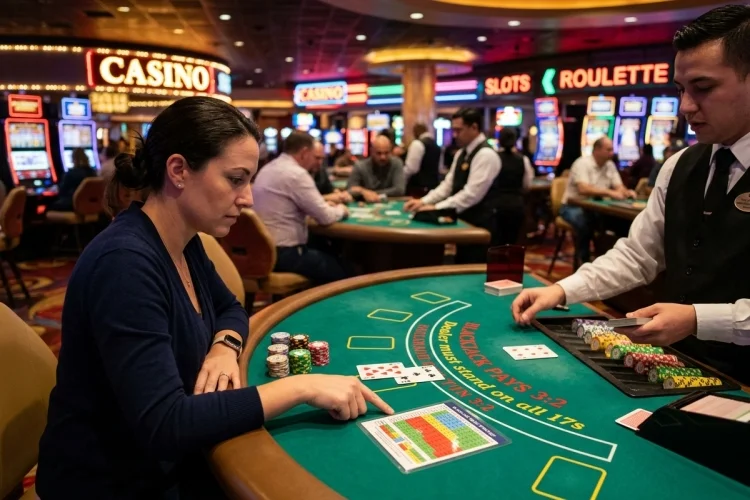


Two blackjack tables can look almost identical but have very different mathematics. One might pay 3:2 for a natural blackjack, another only 6:5, while a third includes side bets offering payouts of 25:1, 30:1, or even more.
That is why understanding How Blackjack Payouts Work requires more than knowing that a normal win pays even money. The payout table affects how much each result is worth, but probabilities matter just as much.
Learning to read those numbers can help you distinguish the main game from insurance and optional side wagers.
Start With “To One” Payout Language
Casino payout notation usually describes profit relative to the amount wagered.
A standard 1:1 payout means one unit of profit for every unit wagered.
If you bet $25 and win:
$25 stake + $25 profit = $50 total returned.
A 3:2 payout means $3 of profit for every $2 wagered. A $20 natural blackjack therefore produces $30 profit plus the original $20 stake.
This terminology matters because players sometimes confuse the stated payout with the total cash returned.
The original wager normally comes back separately when the bet wins.
Why 3:2 Is Better Than 6:5
The difference between 3:2 and 6:5 is one of the most important payout details on a blackjack table.
At 3:2, a $100 natural produces $150 profit.
At 6:5, the same winning hand earns only $120.
The $30 difference occurs every time a natural blackjack wins.
Wizard of Odds explains that a 3:2 natural pays 1.5 times the wager while 6:5 pays only 1.2 times. Its analysis shows that switching to 6:5 materially increases the house advantage when other rules remain unchanged.
The site’s broader rule-variation analysis also shows that blackjack payout rules have a significant effect on expected return.
This is why comparing table rules can matter more than choosing a visually nicer table.
An Ordinary 21 Is Not Always a Blackjack
A common beginner mistake is assuming every hand totaling 21 earns the blackjack premium.
It does not.
A natural blackjack specifically refers to an Ace plus a ten-value card as the original two-card hand.
If you begin with 7-5 and hit a 9, you reach 21, but the hand is normally just an ordinary winning 21 and pays 1:1.
The same issue appears after splitting.
Pagat notes that if split Aces receive a ten, or a split ten receives an Ace, the resulting two-card 21 normally does not qualify as blackjack.
Knowing this prevents a surprising payout when a hand visually looks like blackjack but is settled at even money.
How Even Money Relates to Insurance
When you hold blackjack and the dealer shows an Ace, some tables may offer even money.
Conceptually, this is closely related to taking insurance on your blackjack.
Insurance can typically be placed for up to half the original wager and pays 2:1 if the dealer’s hidden card completes blackjack.
Wizard of Odds explains that taking insurance while holding blackjack effectively converts the outcome into a guaranteed 1:1 profit in the standard setup: if the dealer also has blackjack, the main hand pushes while the insurance wins; if the dealer does not, the blackjack wins but the insurance stake is lost.
That sounds comfortable, but comfort and expected value are not the same thing.
Standard basic-strategy analysis generally treats insurance as an unfavourable wager without additional information about deck composition.
Large Side-Bet Payouts Can Be Misleading
Modern blackjack tables often display side bets with much larger payouts than the main game.
For example, 21+3 uses the player’s first two cards and dealer’s upcard to create poker-style combinations.
Depending on the paytable, straight flushes, three of a kind, straights, and flushes can receive premium payouts.
Wizard of Odds has analysed numerous 21+3 schedules. In one six-deck version, a 9:1 paytable produced a calculated 3.24% house edge. Another six-deck version with different payouts produced a much larger 13.39% house edge.
That is a powerful example of why headline prizes should not be evaluated by payout size alone.
Two bets with the same name can have very differnt mathematical values depending on the exact paytable.
Splitting Changes Your Total Exposure
Splitting does not create a bonus payout.
Instead, you place an additional wager equal to the first stake and play two hands. Each is then settled according to its own result.
Suppose you wager $25 and split.
You now have $50 total on the table.
If both hands win at 1:1, you earn $50 profit. If one wins and one loses, the two main results offset each other before considering any additional doubles or side wagers.
If you double one of those split hands, even more money becomes exposed.
This is why a $25 starting wager does not necessarily mean $25 is the maximum amount needed for the round.
A Push Is Not a Payout
A push can feel like a small win because no money is lost.
Mathematically, however, there is zero profit.
If both player and dealer have 18, the player’s original wager is normally returned. If both have natural blackjack under conventional rules, that also produces a push.
This distinction becomes important when reviewing gambling results.
Counting pushes as wins can make a session appear more successful than it actually was.
A practical record should distinguish between money won, money lost, and wagers simply returned.
Surrender Has Its Own Settlement Rule
Late surrender allows the player to give up certain hands after the dealer checks for blackjack.
Instead of risking the full wager, the player forfeits half and receives the other half back.
For example, surrendering a $40 wager normally means losing $20 and recovering $20.
This is technically not a winning payout.
It is a rule that reduces the loss in situations where surrender is strategically appropriate.
The availability of surrender can also affect the overall house edge, which is why it appears among the variables used in blackjack rule analysis.
Small Rule Changes Add Up
Players sometimes focus only on the payout for blackjack while ignoring everything else.
But overall expected return also depends on dealer soft-17 rules, number of decks, doubling permissions, resplitting, surrender, and how much is paid for a natural.
Wizard of Odds’ rule-variation data demonstrates that each condition can shift expected return by a measurable amount.
The UK’s Gambling Commission similarly describes blackjack as a banker game containing an inbuilt advantage for the house.
Payout tables are therefore only one part of the story.
A table advertising exciting side bets or a low minimum stake can still use rules that produce a less favourable mathematical structure.
Read the Table Before Placing the First Bet
Before joining a blackjack game, check at least the natural-blackjack payout.
Then look at whether the dealer hits or stands on soft 17, whether doubling after a split is allowed, whether surrender is offered, and which optional wagers appear.
If side bets interest you, read their payout table seperately.
Do not assume a 25:1 prize is attractive simply because the number is large. Probability determines how valuable that payout really is.
Also remember that basic strategy can reduce avoidable decision errors but does not remove the house advantage or guarantee a profit.
Blackjack outcomes can vary considerably over a short session.
Understanding How Blackjack Payouts Work means looking beyond the biggest number printed on the table. A 3:2 natural, 6:5 natural, insurance bet, side wager, split, or surrender all use different settlement rules.
Before playing, compare the complete paytable and table rules together. Knowing what each outcome pays makes it much easier to understand the real cost and value of every wager.