

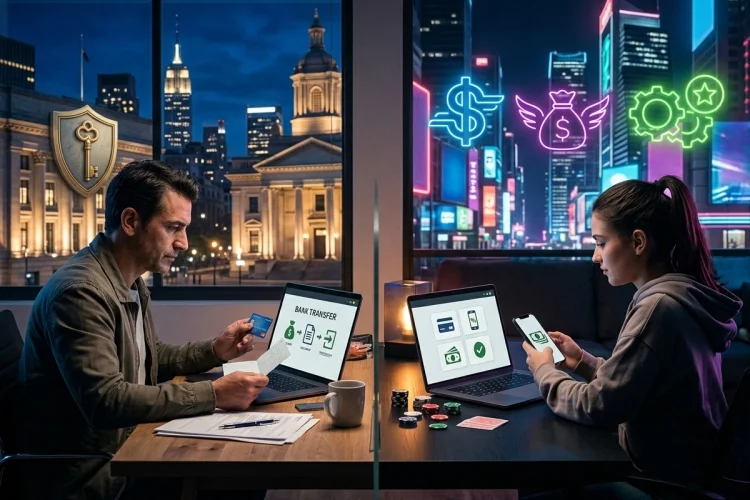
Online casinos usually offer several ways to move money, but direct bank payments and digital wallets remain two of the most common choices.
Both can be convenient, yet they create different experiences when a player deposits, withdraws, verifies an account, or converts currencies.
The bank transfer vs e-wallet casino payments debate is not simply about which option is faster. A bank transfer connects the casino directly to a personal bank account and may support larger amounts.
An e-wallet such as Skrill, Neteller, or PayPal adds another payment layer, potentially improving convenience while reducing how often bank details are entered at individual websites.
The best method depends on the complete transaction journey. A deposit credited in seconds offers little advantage if the later withdrawal is expensive, delayed, or unavailable in the player’s country.
Before paying, users should compare processing times, total fees, ownership rules, transaction limits, supported currencies, and the operator’s licensing status.
How Bank Transfers and E-Wallets Work
A bank transfer moves funds between the player’s bank and the casino through a banking network. In the United States, ACH is one example of an electronic network used for transfers between banks and credit unions.
Other markets may use SEPA, open banking, or domestic instant-payment systems.
An e-wallet stores a balance or links to another funding source. The player pays through the wallet instead of entering full bank or card details at each casino. Availability depends on the operator, provider, and local regulations.
Deposit and Withdrawal Speed
E-wallet deposits are commonly credited within seconds after approval. Skrill describes wallet funding and gaming payments as near-instant, while Neteller promotes instant online payments.
Traditional bank transfers can take longer, especially across borders. However, instant banking is narrowing the difference. The European Central Bank states that instant euro payments can arrive within seconds, 24 hours a day and 365 days a year.
Withdrawals include two stages: casino approval and provider delivery. Even a fast wallet cannot receive funds until the operator completes any required security or account review.
Fees and Currency Conversion
Domestic bank transfers may be inexpensive, while international wires can include sending, receiving, or intermediary-bank charges. Foreign-exchange margins may further reduce the final amount.
E-wallet costs vary by provider, country, funding source, and account status. A casino deposit may be free while loading the wallet, converting currency, or transferring money to a bank carries a charge.
Skrill, for example, supports several withdrawal routes with separate conditions.
Players should compare the total cost from the original funding source to the final withdrawal destination. The fee displayed beside the casino deposit button does not always represent the complete transaction cost.
Security, Privacy, and Verification
Bank transfers use bank authentication and create a clear financial record. E-wallets provide more separation because the casino normally interacts with the wallet rather than the underlying bank account.
Digital wallets commonly use encryption and account-security controls to protect stored payment information. Players should still use unique passwords and activate multi-factor authentication whenever it is available.
The payment account should normally belong to the casino account holder. Operators often restrict third-party funding, while closed-loop systems return withdrawals to the original deposit method to reduce fraud and money-laundering risks.
Limits, Availability, and Bonus Conditions
Bank transfers may be more practical for larger transactions because banks and casinos often provide higher limits for verified customers. E-wallet limits can depend on location, account verification, funding method, and provider rules.
A casino may accept an e-wallet for deposits but exclude that method from selected bonuses. Some platforms may also offer bank deposits without supporting withdrawals through the same banking option.
Players should review minimum deposits, maximum cash-outs, bonus exclusions, pending periods, currencies, and withdrawal routes before sending money.
Choosing the Right Casino Payment Method
1. Bank Transfer Is Better When…
A bank transfer may suit users who prefer direct banking, larger practical limits, and straightforward financial records. It can be especially useful for fewer, higher-value transactions when the casino supports efficient bank withdrawals.
2. An E-Wallet Is Better When…
An e-wallet may suit mobile users who value rapid deposits, convenient authentication, and reduced sharing of bank details. It is most useful when the same verified wallet supports both deposits and withdrawals.
The best choice depends on the casino’s actual terms rather than general assumptions about the payment method.
Bank transfer vs e-wallet casino payments is mainly a choice between directness and flexibility. Bank transfers are familiar, traceable, and potentially suitable for larger amounts, but standard or international payments can be slower.
E-wallets often provide faster deposits and an additional privacy layer, although funding, conversion, and bank-withdrawal fees may apply.
Before choosing, confirm that the casino is licensed in your jurisdiction and that the selected method supports withdrawals. Complete verification early, use only a payment account in your name, and set a spending limit you can comfortably afford.
The best method is not merely the fastest deposit option; it is the one with transparent costs, reliable cash-outs, and controls that support responsible play.
